collapse

Resources

Stud of St. John's Game

No Stud when we lose.
2025-26 Season SoG Tally
Ross4
James Jr1
Parham1

'24-25 * '23-24 * '22-23
'21-22 * '20-21 * '19-20
'18-19 * '17-18 * '16-17
'15-16 * '14-15 * '13-14
'12-13 * '11-12 * '10-11

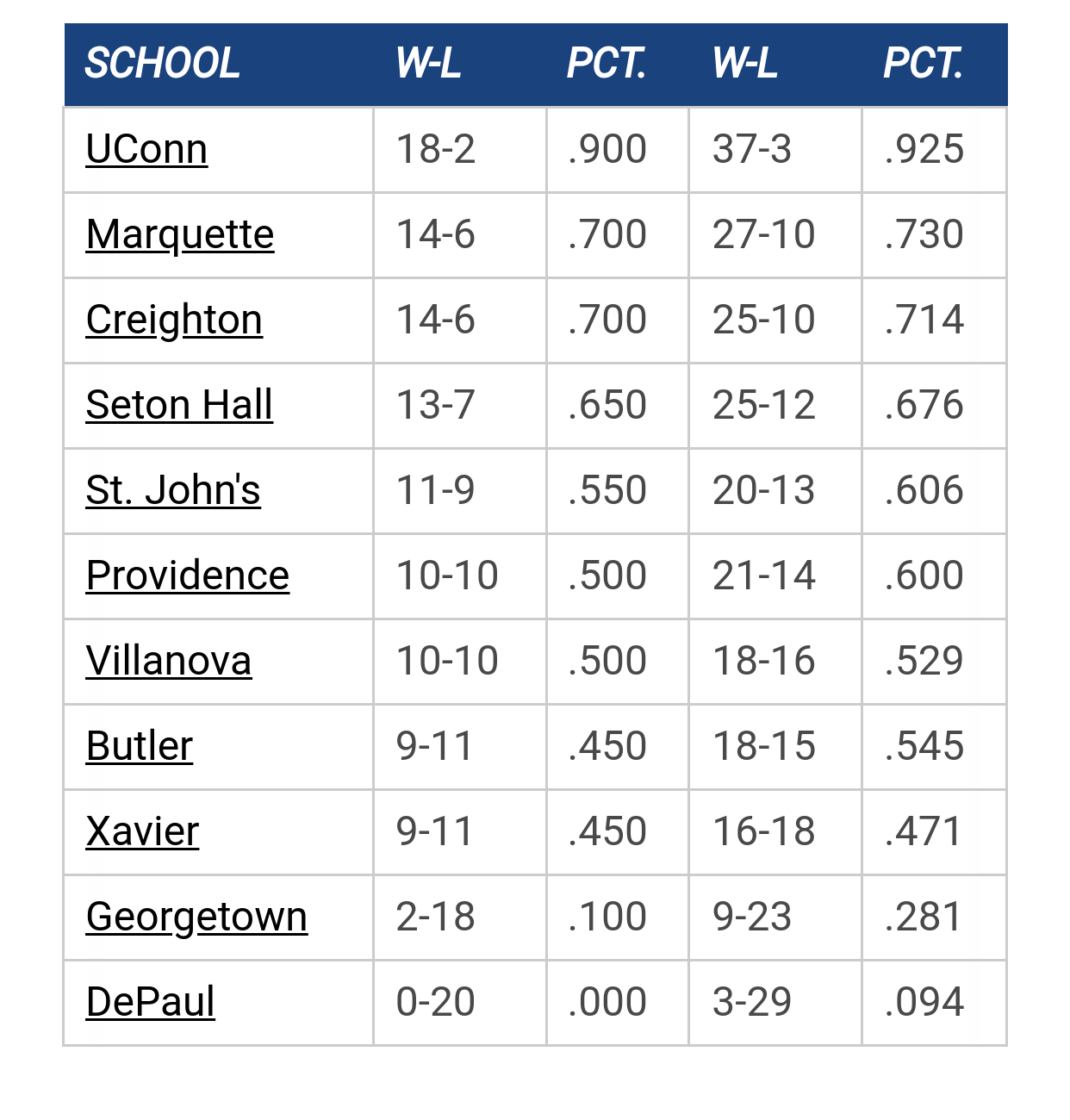
Big East Standings

Recent Posts

Please Register - It's FREE!

The absolute only thing required for this FREE registration is a valid e-mail address. We keep all your information confidential and will NEVER give or sell it to anyone else.
Login to get rid of this box (and ads) , or signup NOW!

Next up: @ DePaul

Marquette
68
Marquette @
DePaul
Date/Time: Jan 16, 2026, 7:30pm
TV: FS1
Schedule for 2025-26
St. John's
92

LAZER

Bracket pools be advised: The wise men who say a deep bench equals a deep tournament run aren't all that wise.


For three seasons, Ken Pomeroy has been charting how frequently teams use players off the pine, and only one ranked in his top 30 has reached the Sweet 16. That was the 2008 Western Kentucky Hilltoppers, who were ousted by UCLA once they arrived at the second weekend. And that lesson applies to a large number of teams in this year's tournament.


Dance Lessons
Want to see what else our research has discovered about tourney truths? Check out the rest of the Dance Lessons series.

March 14
Does defense win titles?

March 15
Do teams live, die by the 3?

March 16
Does depth matter?


This season, there are three tourney teams -- No. 6 Tennessee , No. 8 UNLV and No. 10 Missouri -- ranked in KenPom's top 30 for bench minutes. It's been a theme recently for the Tigers, who were ranked in the top 50 in this category last season and still made the Elite Eight, but the Vols were forced into reshuffling after the suspension of several main-rotation players earlier this season.


Of course, three seasons aren't much of a sample to say definitively whether or not these teams will be doomed in their quest to reach the Sweet 16. To be fair, we went back to the 20 Final Four teams from the past five seasons to see whether a deep run could be achieved by a squad relying heavily on its bench.


Not a single one was ranked in the top 25 in bench points scored per game.


Minutes and production are two different stats; put the two together, and the result points toward a core group being much more successful than a 10-man rotation.


Less often equals more, especially in the tournament. That's not to say title contenders don't rely on role players to contribute, but starters are key to a championship.

Using the Bench The Most
Tournament teams with most bench minutes per game.

Team Name Bench Minutes Per Game
Texas Longhorns 80.6
Michigan State Spartans 79.6
Missouri Tigers 79.1
UNLV Rebels 78.2
Murray State Racers 77.0

When we extended our research further, we found that on the past 10 national championship teams, starters accounted for at least 65 percent of the minutes -- and all but two used starters more than 70 percent, proving successful teams don't spread floor time more than is necessary.


The same goes for this season's top four seeds. Just like the past 10 title teams, Kansas , Kentucky, Duke and Syracuse all play their starters more than 67 percent of the minutes. The Wildcats and Blue Devils both use them more than 70 percent.


No. 2-seeded Ohio State and No. 3-seeded Georgetown are two teams that take the maxim to the extreme, running their starters more than 65 percent of the minutes and relying on them for more than 60 of their total points per game. No. 6 seed Notre Dame , No. 10 seed Saint Mary's and No. 12 seed New Mexico State also fall into that category.

Using the Bench The Least
Tournament teams with fewest bench minutes per game.

Team Name Bench Minutes Per Game
Ohio State Buckeyes 36.1
Notre Dame Fighting Irish 37.8
Georgetown Hoyas 40.2
Siena Saints 43.7
Saint Mary's Gaels 44.8
We're not ignoring the fact that injuries happen, and teams need their benches when they run into foul trouble. But our findings prove that a strong core of three to five players averaging 25 or more minutes a game -- or around 40 percent of the total -- is an ideal scenario.


Only three of the 80 teams that have made the Elite Eight since 2000 had fewer than three players average 25 or more minutes -- Missouri in 2009, Davidson in 2008 and Florida in 2000. And when you consider that Stephen Curry accounted for 33 percent of the Wildcats' points that season, it's kind of tough to argue that it was depth that took Davidson that far.


This year's field is actually playing even tighter rotations than the "rule of three at 25-plus" dictates. Three of the four No. 3 seeds (New Mexico , Georgetown and Baylor ) have four players averaging 25 or more minutes, as do No. 4 seeds Maryland and Wisconsin . Meanwhile, No. 5 Butler has five players averaging more than half of the team's total minutes, as do No. 6 seeds Notre Dame and Marquette.


If you're looking for an exception to the rule, eye Kansas State, Texas, Missouri and Washington, teams that all have fewer than three players averaging 25-plus minutes per game.


But odds are slim that any of them will emerge with a title -- because when it comes to dancing in March, it doesn't take depth to go deep.

Previous topic - Next topic